

Most old oak can be saved, and some of it cannot
We spend most of our time in this town talking people out of tearing up their oak. The floors in the Cape Cods and colonials built here after the war are solid, and the large majority refinish well. That makes it all the more important to be straight about the exceptions.
Some boards are finished. When that is true, sanding them again wastes a day and a good finish, and the right move is to take them out and put in oak that will last.
The signs a board is done
The clearest sign is wood that has run out. A strip floor sanded too many times starts showing its tongues along the board edges, and eventually the nail heads appear in neat rows. There is no oak left above the joint to work with, and another sanding would only cut deeper into structure.
Water is the next most common reason. An old plumbing leak under a bathroom, a kitchen sink or a radiator line leaves boards that are cupped, stained black where moisture reacted with the tannin in the oak, and sometimes soft to the touch. Black staining from water sits deep in the fibers. It does not sand out, and bleaching it rarely gets it all the way gone.
Pet accidents in the same spot over years soak in the same way and leave the same kind of dark ring. Boards split by heavy impact, or chewed up by a past remodel, round out the list. Any one of these can mean a handful of boards or most of a room.
What sits under a damaged floor
Pulling up the bad boards tells you what the subfloor has been dealing with. Where a leak went on for a while, the planks or plywood underneath can be stained, delaminated or soft enough that a screwdriver presses into them. Laying new oak over that is asking for squeaks, movement and a repeat failure.
So the subfloor gets corrected before anything new goes down. Usually that means cutting out the weakened section and patching it with new plywood to the same thickness, screwed down to the joists so the surface is flat and firm. Sometimes it is just refastening a few loose areas. Occasionally it means finding that the leak is still active, in which case the plumber goes first and the flooring waits.
This is the part of a replacement job that nobody will ever see, and it decides whether the new floor stays quiet and flat for the long haul. The Prairie Village floor replacement page goes into how we scope this before any boards come up.
Weaving new boards in or starting over
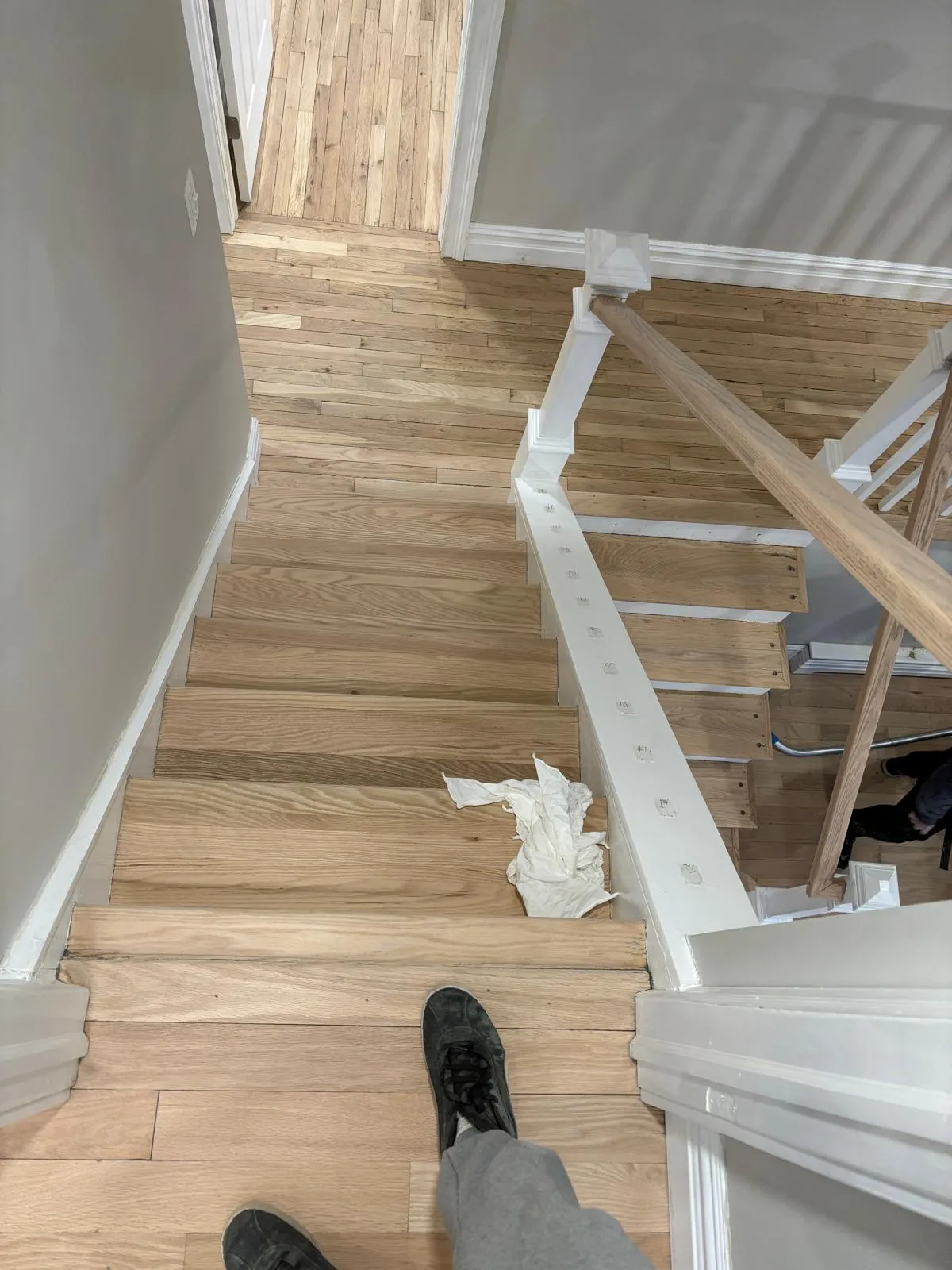
When the damage is contained, the best answer is usually partial replacement. Damaged boards are removed in a staggered pattern instead of along one straight line, so their ends land at different points. New boards are then woven into those gaps, tongue to groove, the same way the floor was originally laid. A straight cut across a room leaves a seam you keep noticing. A staggered weave lets the repair disappear into the field.
When most of a room is damaged, or the subfloor needs work across the whole area, a full tear-out makes more sense. It also makes sense when the remaining boards are close to their last sanding anyway, since a weave would bond new wood to old wood that has little life left.
Deciding between the two is mostly about counting. How many boards are past saving, how much life the rest has, and how many rooms connect to this one. Thiago walks it with you and shows you where he would draw the line before anything comes out.
Making new oak read as original
A replacement only works if it disappears, and that comes down to matching. The width has to be right, since older strip floors were usually a narrow strip and modern stock is often wider. The species has to match, red oak to red oak or white to white, because the two take finish differently. Grade matters too: a floor full of knots and color variation will not blend with clean, uniform boards.
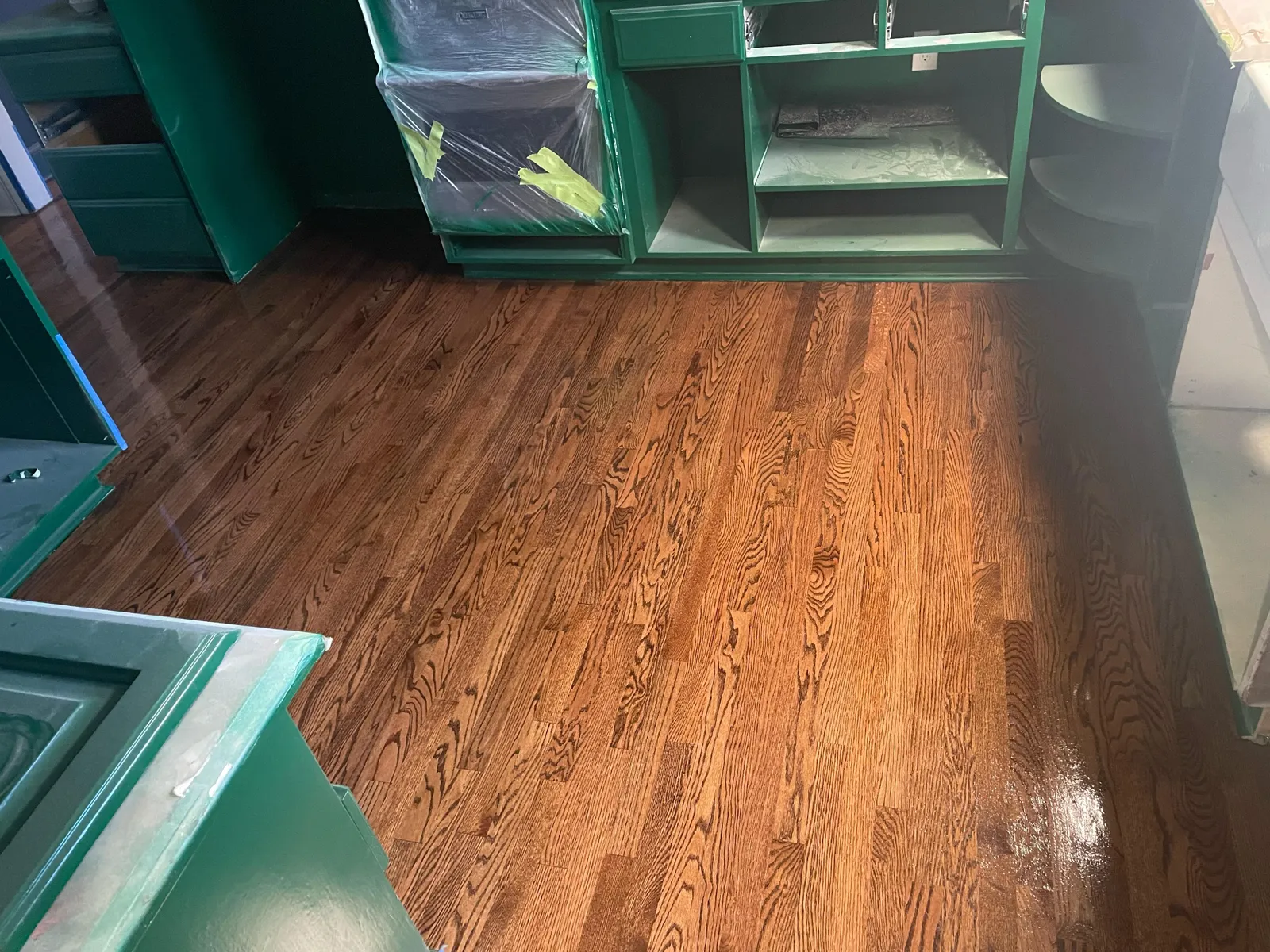
Even a perfect match starts out paler than the existing floor, because the old oak has aged. That is why the new boards get sanded together with the surrounding field and finished in the same coats. Sanding both at once levels the surface across the old and new boards, and a shared finish brings the color into line.
Where the replacement area runs into a doorway or the next room, we carry the weave through the threshold rather than stopping at a transition strip, so the floor reads as one.
Living around the work while it happens
A replacement takes over part of the house for a while, and it goes smoother when that is planned for. The room with the bad boards gets emptied completely, along with any closet that shares its floor, since subfloor work often runs under the doorway. Whatever comes out needs a home in a room nobody is working in.
The new oak sits inside the house for a stretch before it is fastened, so the boxes need a dry spot in or near that room, never the garage or a damp basement. Doors to the work area stay shut while there is dust in the air. On a job that started with an old leak, the plumber’s repair has to be finished and dried out before any of this begins.
If what you need is closer to a handful of cracked or gouged boards, it may be a repair rather than a replacement, and the visit will make that clear.
Questions about replacing part of a floor
Can you replace boards without refinishing the whole room?
Sometimes, on a floor that was finished recently, where the new boards can be stained and coated by hand to blend in. On an older finish a spot patch reads as a patch, so we usually recommend sanding the room with the new boards in it. You hear which case you have on the visit.
Can you save the boards that come out?
Sometimes. Boards pulled from a closet or from under a cabinet run can be reused in a more visible spot, since they share the floor’s age and color. Damaged boards themselves are not worth saving. We plan where good salvaged boards go before anything is pulled up, so they are not wasted.
Do you fix the subfloor or do we need someone else?
We correct the subfloor ourselves as part of the job, including patching with new plywood and refastening loose areas. If we find an active leak, that goes to a plumber first. We will not lay new oak over wet or moving wood just to keep a schedule, because it would fail again.
Find out how much of the floor can stay
Most replacement jobs turn out smaller than people fear once someone reads the floor board by board. If you are planning an addition next to the damaged room, our solid hardwood installation work covers matching new rooms to the old oak.
Have the damaged boards read before anything comes up
Thiago comes out from Shawnee, checks what is past saving and what is not, and writes down a straight price that explains where the line falls. More about our work around town sits on our Prairie Village page.