
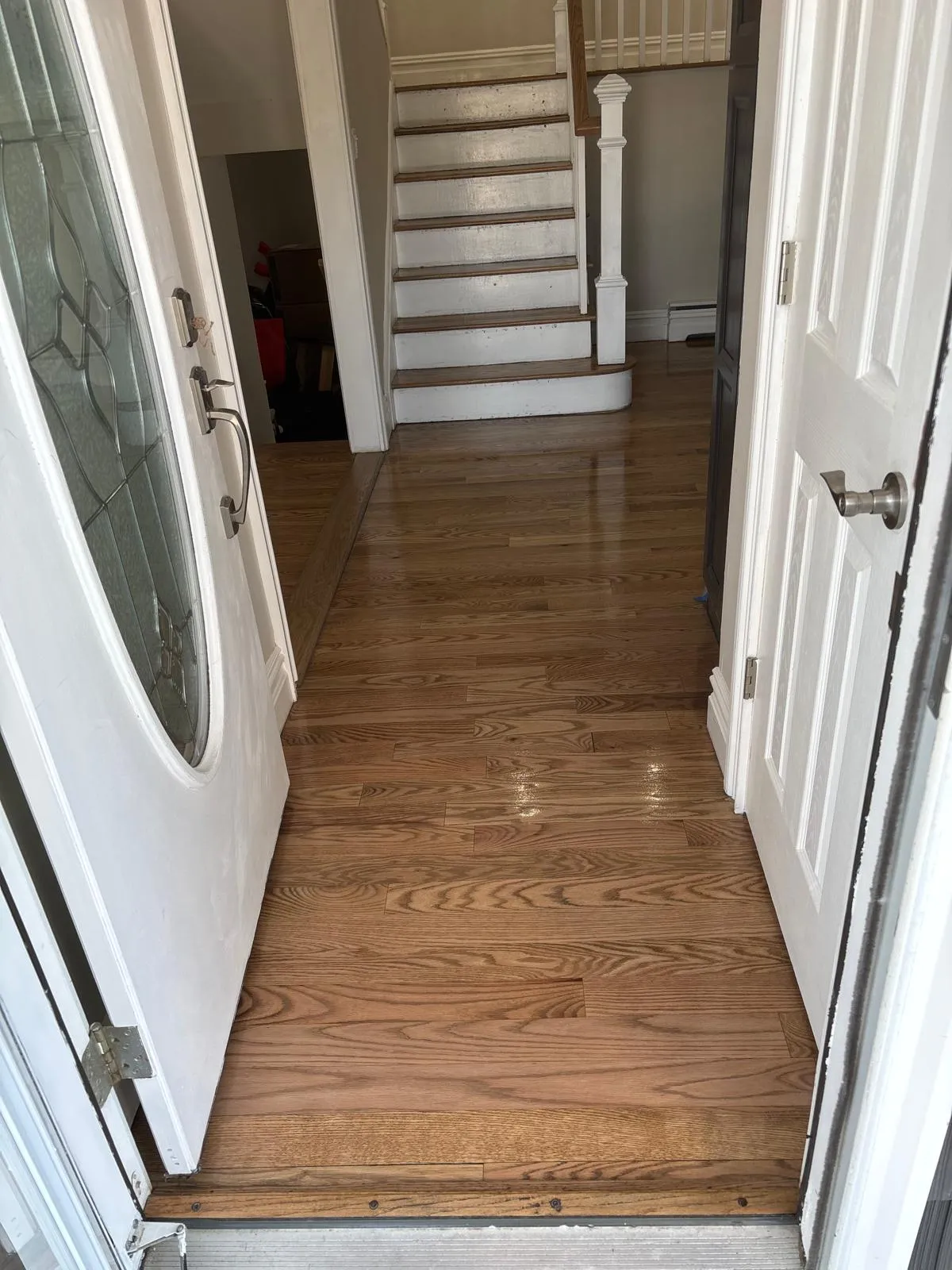
Olathe’s buried hardwood, restored board by board
Somebody carpeted over it. Somebody else glued vinyl on top of that. Underneath there is usually narrow oak, and the only honest question is how much of it is left. We open a spot and tell you what we found.
What is actually under the carpet
Restoration starts with a hole. Before we put a number on anything, we pull back a corner of the carpet in a closet or behind a door and look at what somebody covered up decades ago. Sometimes it is red oak in narrow strips, tight and dark and sound under forty years of pad. Sometimes it is pine that was face-nailed twice, patched with plywood where a floor register used to sit, and painted around the outline of a rug that left in 1988. Both are jobs. Very different jobs.
The older streets in Olathe hold both. Around downtown and near the county courthouse, houses from before the war got narrow oak, or pine that was never meant to be seen. Havencroft and the blocks off Santa Fe Street got strip oak that was thin from the start. This was a farm town and a Santa Fe Trail stop long before it was a suburb, and the carpenters here assumed a rug would cover their work. That is why so much of it survived, and why it is in the shape it is in.
So the first honest thing we can tell you is that we do not know yet, and neither does anybody quoting you over the phone. Thiago drives down from the Shawnee shop, opens a spot, measures, and writes you a straight price with the unknowns spelled out instead of buried.
What the work covers
- Carpet, pad, tack strip, and staples pulled by hand
- Wood above the tongue measured before a price
- Glue, tar paper, and old adhesive taken off the face
- Paint and bleed lifted where the rug edges stopped
- Missing runs remade in matched species and width
- Color built up so new boards sit next to old ones
Deciding what stays and what goes
The exploratory look
We open a small area first. That patch tells us species, width, fastening, and whether the boards sit on a solid subfloor or on sleepers. It tells us whether we are fighting adhesive, tar paper, or four decades of staples, which moves the labor more than anything else.
Measuring what is left
The number that decides the project is how much wood sits above the tongue. Sand into the tongue and the board is finished. We check it in several rooms, because a hallway that has taken ninety years of traffic reads differently than a bedroom that spent its life under a bed.
Filling the gaps
Old houses lose boards. A register gets moved, a wall comes out, a plumber cuts a trench and puts back whatever was on the truck that morning. We remake those runs in matched stock and weave them into the existing courses so the end joints break naturally.
The walkoff
Once the finish has cured we walk the floor with you in daylight, which is the only light that tells the truth about restored wood. Anything you point at gets handled before we call it finished. The house gets left cleaner than we found it.
Some floors do not come back
We would rather lose the work than take restoration money for a floor that cannot deliver. Some are already at the tongue because two crews sanded them before us. Some sat under a slow toilet leak for a decade and have gone punky through. Some were stapled and glued so many times that the face is gone before a sander touches it. When that is what the patch shows in an Olathe house, we say so standing right there, and we talk about a faithful replacement in the same species and width instead.
Kansas weather belongs in this too. A wet spring and a bone-dry January move wood that has spent decades under carpet with no finish on it. Boards cup, flatten, and cup again, and a floor that has been through forty of those cycles can lie flat one week and not the next. Flattening a cupped floor in the wrong season is how you lose a floor that patience would have saved.
How we do business
You call, Thiago comes out, and you get a straight price in writing. If the floor needs less than you feared, you will hear that, and if it needs more, you will hear it before work starts rather than in an invoice afterward. He has run it this way since 2012.
Matching wood that nobody mills anymore
Narrow red oak strip is still made. The pine widths a 1920s Olathe carpenter reached for are not, and neither is grain off a tree that grew slowly enough to earn it. When a floor needs new runs we go hunting through ProSource Wholesale and the reclaimed market for stock that reads right: close enough in grain that the eye quits looking for the seam. That hunt is most of the work on a restoration. Anybody can screw down a board.
Color is the other half. New wood takes stain differently than wood that has been oxidizing under a carpet pad since the Nixon years, so replacement boards get built up in layers until they sit down beside the originals. We run LOBA finishes and pick a sheen that suits the age of the floor. Heavy gloss on eighty-year-old oak makes it look like a photograph of itself.
Where these calls come from
Most of our Olathe restoration work sits in the older core: the blocks around downtown, and the early postwar houses where original strip oak is still down under whatever came after it. It all runs out of the same Johnson County shop in Shawnee.
Being fifteen minutes out means the exploratory look a restoration needs is easy to schedule. The Olathe page covers the rest of what we do in town, and the gallery has floors that started out worse than yours.
Related work: Floor Repair · Dustless Sanding
Questions we get on old floors
Real questions off real phone calls. If yours is not here, call and ask it. You get one of us, not a call center.
Need more help?
Thiago answers flooring questions all day and enjoys it.
(913) 915-3193hardwoodkingsinc@gmail.comThere is carpet over our whole main floor. How do we find out what is under it?
We pull a corner in a closet or behind a door. It takes a few minutes and leaves nothing you will see later. That corner tells us species, width, fastening, and roughly how much wood is left, which makes the rest of the conversation real instead of a guess.
The boards are full of staples from the carpet pad. Is that a dealbreaker?
No, it is labor. Staples come out by hand first, because a sander that catches one will tear the drum and leave a mark down the room. Older Olathe floors that carried two or three generations of carpet can hold thousands of them.
How much wood has to be left for this to work?
Enough to sand without reaching the tongue. Thiago measures that on the first visit, in more than one room. If a past crew already took the floor down close, we will not sell you a sanding that ends in exposed tongues.
Somebody painted the edges of our floor. Does that come off?
Usually. Paint that stopped where a rug started is common in the older houses near downtown, and it comes off with the rest of the surface. Where it soaked deep into open grain we test a patch first.
Half a run of boards is missing where a wall used to be. Can that be filled?
Yes. We remake the missing run in matching species and width and weave the ends into the courses around it so the joints break the way the original ones do. A straight seam running across a room is what makes patchwork obvious.
How do we get a price for restoring our floor?
Call (913) 915-3193 or send the contact form with a rough description of the rooms and whatever is covering the floor now. Thiago drives down from Shawnee, opens a spot, measures the wood, and hands you a straight price in writing.
Something old under your carpet?
Call and describe what you are looking at, or what you think you are looking at. Thiago comes out, opens a spot, measures the wood, and gives you a straight price in writing either way.
Or see the finished work first. Family-run out of Shawnee since 2012, locally certified and licensed, and rated 5.0 on Google.