

When a Prairie Village floor has nothing left to sand
Most of the oak in these houses can be refinished, and we will tell you so when it can. Some of it cannot. Boards worn down to the tongue, wood blackened by an old leak or a pet, a subfloor that gives underfoot: past that point the answer is hardwood floor replacement, laced in where the damage sits or laid wall to wall, and finished so it looks like it was always there.
Signs that refinishing has run its course
A floor that has been sanded many times starts to show its own skeleton. Nail heads appear as dark dots running along every board. The tongue shows up as a thin line between strips, or the top edge of a board breaks away and leaves a gap that will not fill. Another sanding only takes more off wood that has none left to give, so those boards need to come out.
Water does a different kind of damage. An old plumbing leak under a bathroom or beside a kitchen sink leaves boards cupped, stained black, and sometimes soft when you press a thumb into them. Pet accidents that soaked in over months do the same thing from the top down, and no sanding reaches the bottom of that stain. Black is the color to watch for, because it usually means the damage runs through the wood itself.
Nearby work
These houses went up in the 1940s and 50s with solid oak as standard, and decades of plumbing changes and moved walls have left their marks on it. We replace damaged sections in homes off Mission Road and across Johnson County, working from a shop twenty minutes away in Shawnee.
Read more on the Prairie Village page and on our main hardwood floor replacement page. Smaller damage, a few boards or a single scar, is usually hardwood floor repair instead, and we will say so.
Related work: Sanding · Staining · Custom · Installation
The order a replacement has to happen in
Out
Damaged boards get cut out back to sound wood, or the whole floor comes up if the damage is everywhere. We stop each cut at a board end so the new pieces can weave back into the old ones.
Subfloor
Whatever sat under the bad boards gets inspected before anything covers it. Soft or swollen plywood is cut out and patched with new sheathing, and loose spots are refastened, so the new oak has something solid to sit on.
Acclimate
New oak spends time inside the house before it is nailed, so its moisture settles closer to the old floor around it. Fastening wood that is too wet or too dry is how a repair opens gaps or lifts at the seams a season later.
Install
Boards are laced into the existing floor one at a time, staggered so the joints never line up in a row. Where old meets new there is no transition strip, only more oak running the same direction.
Sand and finish
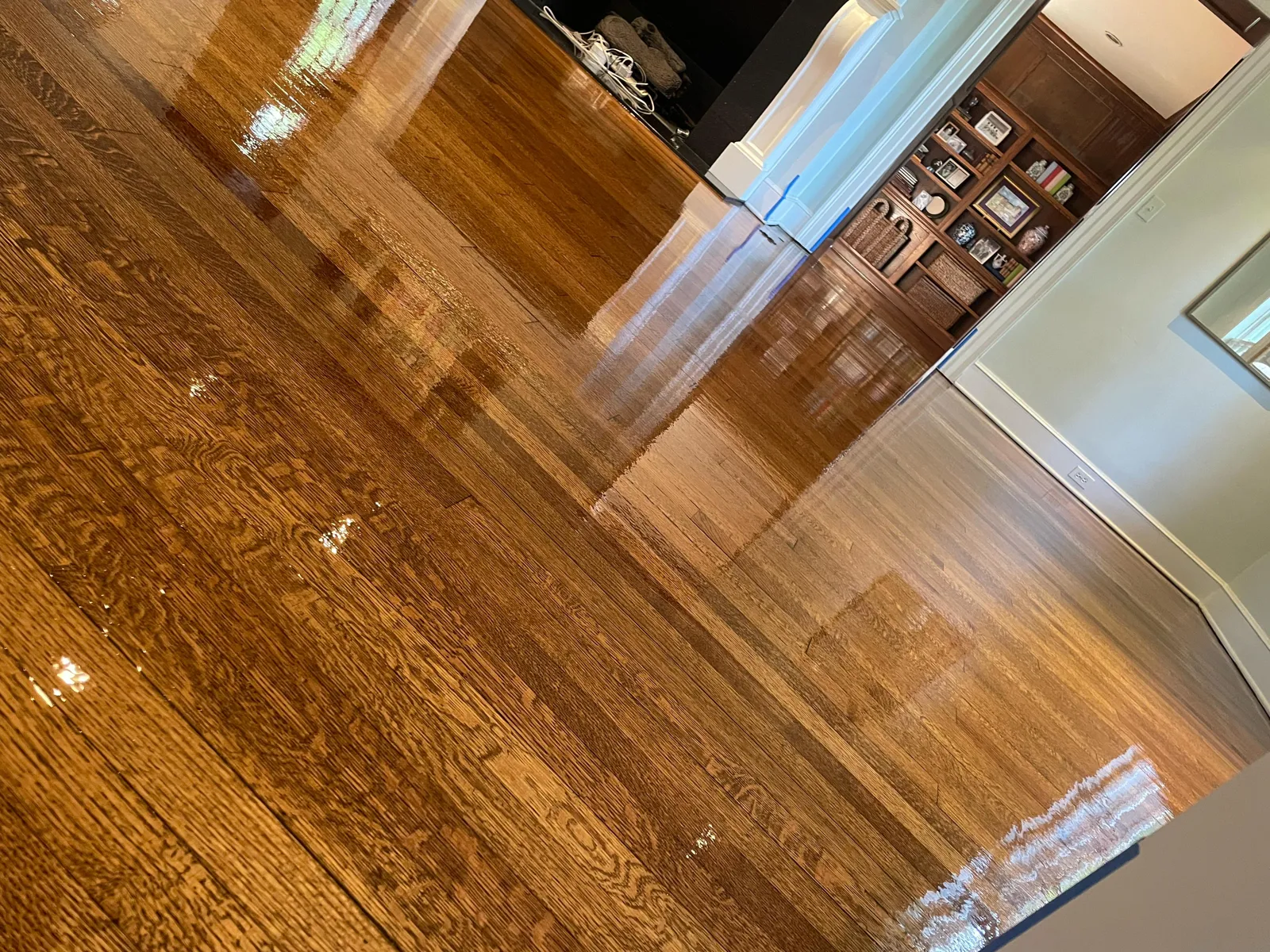
Old and new get sanded flat together and finished in the same coats on the same days. That shared finish is what lets a replacement read as one floor.
Lacing in a section or taking the whole room out
A partial replacement is usually the better job when the damage is contained. We remove the bad boards in a staggered pattern, so the edge of the repair zigzags the way the original floor was laid, and weave new strips in. Done well, you cannot find the line once it is sanded and finished. It also keeps the oak that is still good, which in these houses is often most of the room.
A full tear-out makes sense when damage runs through much of the space, when the floor has been sanded thin nearly everywhere, or when the subfloor needs work wall to wall. It also gives you a clean start if you want a different board direction or width. We will tell you which side of that line your floor falls on, and why, before you decide anything.
Either way, plan on the room being out of use for the stretch it takes to remove, correct, install and finish. We give you that schedule in writing up front, along with which rooms stay open while we work.
The people doing the work
Thiago Reis has owned Hardwood Kings since 2012 and still walks every floor before it is priced. The crew that pulls your damaged boards is the same one that lays the new oak and finishes it, so nothing gets handed off halfway through. Licensed, certified, and rated 5.0 on Google by customers across the metro.
New oak that reads like the original
Matching starts with a tape measure. Strip widths vary from house to house, and a new board a hair wider than its neighbors shows from across the room. We match the width and the species, red oak to red oak and white to white, and buy through ProSource Wholesale, which carries a far deeper range than a retail showroom. If a true match does not exist, you will hear that before anything is ordered.
Additions are the other common case here. When a room gets added on, we extend the existing hardwood into it and lace the new boards into the old at the doorway, with no threshold butted in between, then finish everything together. Done that way, the addition reads as part of the original house, and nobody walking through can tell where the old floor stops.
Tone is the last piece. New oak starts pale beside boards that have aged under decades of daylight, so we sort each bundle for grain and color before it goes down, setting the closest boards right against the old ones. Sanding everything back to fresh wood together closes most of the remaining gap, and the stain or clear finish you pick then goes over old and new in one pass.
Replace, or keep sanding?
- Nail heads showing as dark dots: replace those boards
- Tongues visible between strips: replace
- Black stains from water or pets: replace that area
- Cupping from an old leak that has since dried: often sandable
- Gray, worn finish over solid wood: sand it
- Seasonal gaps in stable boards: fill during a refinish
See replacement and refinish work in the gallery, or send us the details.
What owners ask when the damage is real
These come from calls about leaks, pets and floors that have simply been sanded once too often. Ask yours the same way.
Describe the damage
Tell Thiago where it is and what it looks like, and he can usually say what kind of visit it needs.
(913) 915-3193hardwoodkingsinc@gmail.comHow do I know if my floor needs replacing instead of refinishing?
Look for nail heads showing as dark dots, a thin line where the tongue shows between boards, black staining from water or pets, and boards that feel soft. Any of those usually means replacement for that area. Gray, dull or scratched wood over solid boards can almost always be sanded.
Can you replace only the damaged boards?
Usually, yes. We cut the damaged boards out in a staggered pattern and weave new strips in, matching width and species, then sand and finish the old and new together. Done carefully, the repair disappears into the rest of the floor and you keep the good oak.
What happens if the subfloor is damaged too?
It gets fixed before any new oak goes down. Soft or swollen sheathing from an old leak is cut out and patched with new plywood, and loose areas are refastened. Covering a bad subfloor with new hardwood only hides the problem until it shows up again.
Will the new boards match my old floor?
We match the strip width and species and source the wood through ProSource Wholesale, which carries far more than a showroom. Once old and new are sanded and finished together, they read as one floor. If a true match cannot be found, you will know before we order.
Why does new wood need to sit in the house first?
Wood takes on or gives off moisture until it matches the air around it. Letting new oak acclimate before nailing brings it closer to the old floor, so the patch does not open gaps or push up at the seams once the seasons change.
How do I get a price for replacing part of my floor?
Describe the damage and the rooms involved, either at (913) 915-3193 or on the contact form. Thiago looks at the boards and what is under them, then gives you a straight price in writing, with the reasoning for replacing or refinishing spelled out.
A straight answer on the damaged boards
Describe what the floor is doing and where. Thiago comes over from Shawnee, checks the boards and what sits under them, and tells you whether it is a repair, a partial replacement or a full tear-out, with a straight price in writing.
Or look through finished jobs first. Thiago has owned and run the company since 2012.