
A Leawood floor tells you what it has left before anybody sands it
Refinishing is the quiet half of this trade. Nothing gets torn out, nothing gets hauled away, and the boards that carry your rooms stay exactly where the builder set them. What changes is the layer on top, and how carefully somebody reads the wood before touching it.
Reading a floor before the machines come out
The first hour on any Leawood job is spent kneeling, not sanding. We want to know three things: how much wood sits above the tongue, whether the boards are lying flat or have started to cup, and what the previous finish is. Those answers change the entire plan, and none of them can be guessed from a doorway. A vent cover comes off, a closet corner gets checked, and a meter goes into the wood and into whatever is under it.
What we find in this city varies more than people expect. Established streets near Lee Boulevard tend to hold site-finished oak with real thickness under it, floors that were meant to be maintained rather than replaced. Move toward the estate homes around Hallbrook and the questions get more interesting, because floors there were specified as a feature, often with borders, pattern fields, and stair work that a resand has to respect rather than flatten.
Then there is the ordinary half of our Leawood schedule, which we like just as much. Kitchen oak worn thin in front of the sink. A run of boards buckled where an ice maker line let go. A bedroom where carpet came up and revealed something worth keeping. Same crew, same reading, whether the room is thirty feet of herringbone or a hallway.
What we check first
- Thickness above the tongue, measured at a vent, never eyeballed
- Whether boards sit flat or have cupped along their seams
- Moisture in the wood and in the subfloor beneath it
- What the old coating is, and how it will come off
- Borders, pattern fields, and stair treads that need matching
- Which boards are past saving and should simply be swapped
Pattern work changes the whole approach
Borders and inlays
An inlaid border runs against the grain of the field around it. Sand that with one direction and one grit and you leave scratch marks across the inlay that catch light forever. Those areas come down with hand work and finer paper, taken slowly, checked from a low angle before any sealer goes near them.
Herringbone fields
Every piece in a herringbone meets its neighbor at a right angle, so there is no with-the-grain direction to follow. We work these on the diagonal, then again on the opposite diagonal, then finish with a buff that erases both passes. It takes longer than a straight-lay room of the same size, and we price it that way from the start.
Stairs and landings
Treads take the hardest wear in the house and cannot be run with a floor machine. They get sanded by hand, edge by edge, and they need to land on the same tone as the floor they connect. When we have replaced treads on a Leawood staircase, matching them to a refinished main level is the part that decides whether the work reads as new or as original.
Wide plank
Wide boards move more with the seasons than narrow strip does, so the gaps between them open and close through the year. We fill what will hold and leave what will not, because a filler forced into a seam that wants to move will simply crack out by February and look worse than the gap did.
Sheen is the decision people rush
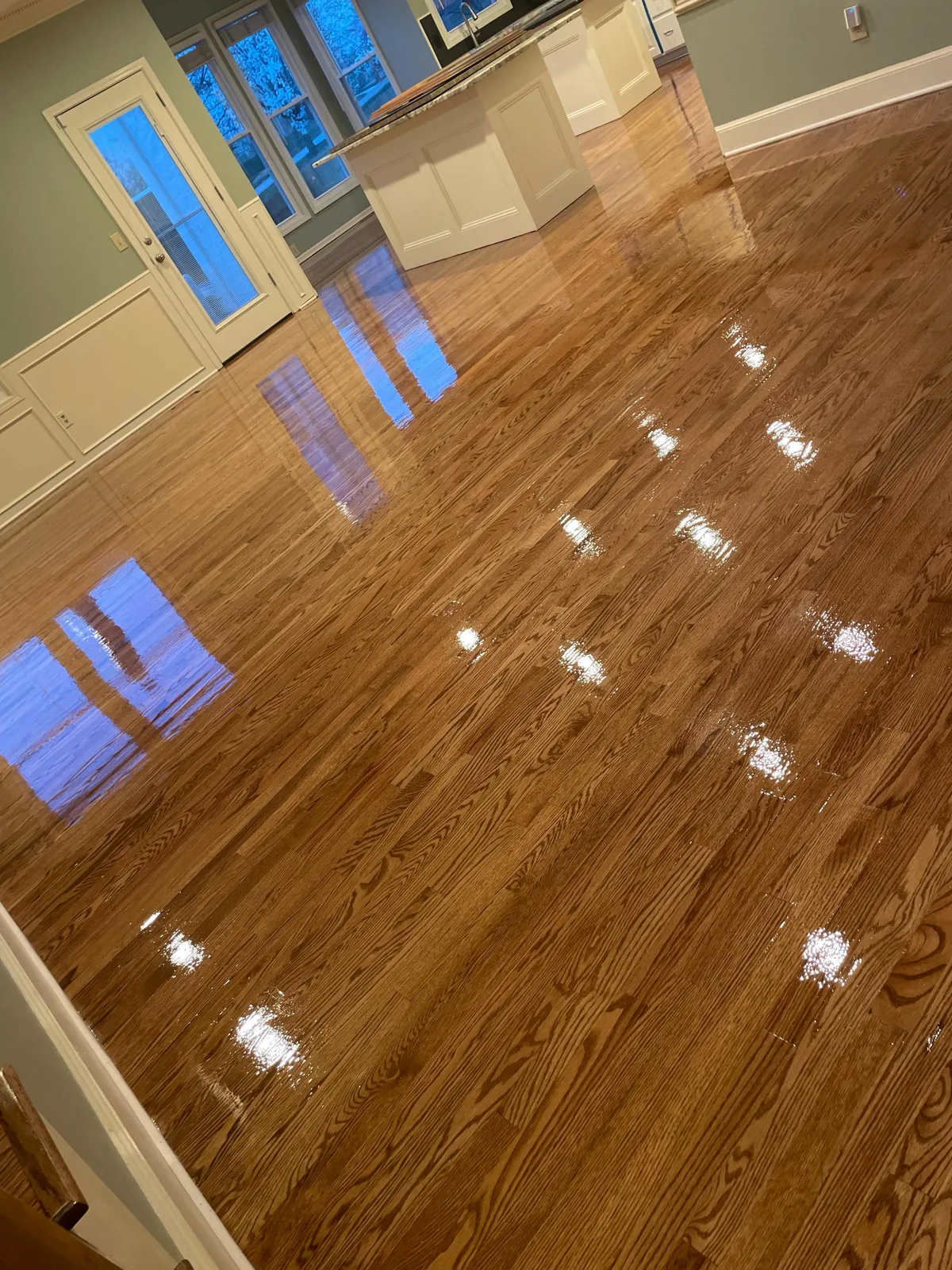
Color gets all the deliberation and sheen gets almost none, which is backwards. Sheen is how the floor behaves in the room every single day. Leawood homes tend to carry a lot of glass, and a glossy finish under that much light turns a floor into a mirror: beautiful for an hour after cleaning, and an honest record of every footprint the rest of the time. That reflective wet look is genuinely gorgeous in the right room. It is also unforgiving in a room where two dogs cross a sunbeam.
Flatter finishes scatter light instead of returning it, so dust and paw prints disappear and the grain of the wood becomes the thing you notice. The trade is that a flat surface shows a scuff more plainly than a satin one does, and it is slightly harder to blend a repair into later. Satin sits between the two and is where most households land once they have seen all three side by side.
So we bring samples and we put them on your floor, in your rooms, and we look at them twice: once in daylight coming through whatever windows you have, and once after dark with the lamps on. A tone that looked warm at two in the afternoon can go flat and gray at eight in the evening, and there is no way to know that from a card in a showroom.
Who is standing in your house
Thiago comes out to look at the floor himself, usually within a few days of the call. He measures, checks what is under and around the flooring, and talks options at more than one budget before anything is written down. The crew is family-run and works out of Shawnee, twenty minutes away, which is why a follow-up question never turns into a two week wait.
Living upstairs while we work downstairs
Most Leawood refinishing happens in an occupied house, so containment is not a nicety. Our sanders draw into vacuum containment, which keeps the fine stuff out of the air where it used to end up on picture frames and inside cabinets. We seal the return vents before a machine runs, because a return that keeps pulling during sanding will distribute dust through the whole system and undo everything the containment did. Doorways get masked, and the path in and out gets protected.
Noise is the honest downside and we will not pretend otherwise. The machine hours are loud in whichever room we are working, though buffing and coating are close to quiet. Tell us if you work from home and we will sequence rooms so the loud stretch is not happening below your desk. Where the layout allows it we work in sections, so there is always a dry route from the door to a bedroom and the house stays usable through the week.
Then there is the part nobody wants to hear: the floor is not finished when it looks finished. Coating cures on its own schedule and rushing it is how a beautiful job gets ruined in week two. Sock traffic comes first, furniture goes back after several days, and area rugs wait considerably longer, because a rug laid down early traps the last of the cure and lifts as a dull rectangle you will see for years.
Around Leawood
Recent work here has included full main-level refinishes in Hallbrook and Whitehorse, along with stair tread replacements matched into those floors. We also handle office and retail suites around Town Center. Realtors call before listings go live, which usually means a tight window, and we will say plainly whether yours fits.
This page is one of several for the city. Here is everything we do in Leawood, the wider Johnson County coverage, and the site-wide detail on hardwood floor refinishing. If you would rather look before you talk, the gallery is full of finished floors.
Related work: Floor Installation · Dustless Sanding · Floor Repair · Floor Restoration
What Leawood callers ask us
Answered the way we would answer standing in your entry, which is plainly.
Straight answers
Thiago takes the calls himself and would rather talk you out of a bad idea than sell you one.
(913) 915-3193hardwoodkingsinc@gmail.comOur floor has an inlaid border. Can it be sanded without wrecking the inlay?
Yes, and that section gets treated as its own job. The inlay runs across the grain of the surrounding field, so it comes down with hand work and finer paper rather than the same pass as the open floor. We check it from a low angle in raking light before any sealer touches it.
Which sheen holds up best in a room with a lot of windows?
Something flatter than gloss, almost always. Heavy daylight turns a reflective surface into a record of every footprint. Flat or satin scatters that light and lets the grain read instead. We put samples down and look at them in your own rooms twice, once in daylight and once after dark.
How long until we can put the furniture back?
Sock traffic comes first, furniture several days after that, and area rugs considerably later. Those windows are not padded. Covering a curing finish traps it and lifts a dull patch you will be looking at long after the job is paid for.
The boards near our ice maker are dark and lifted. Sand or replace?
Replace those boards, then refinish everything together. Water that lifted a board has been in the wood, not on it, and no amount of sanding brings that back. We cut out what is gone, match the replacements in, and the whole field gets coated as one floor.
Can our staircase be brought to the same tone as the main level?
That is exactly the reason to do the two together. Treads are sanded by hand and take stain a little differently than the floor does, so we sample on the treads themselves rather than assuming. Done at the same time, the stairs read as original to the house.
How do we get a price for refinishing our floors?
Call (913) 915-3193 or send the contact form with the rooms and what is on the floor now. Thiago drives out from Shawnee, usually within a few days, measures, checks what is underneath, and gives you a straight price in writing with the reasoning attached.
Wondering what your floor has left?
Tell us the rooms and what you are seeing, and Thiago will come look at the wood himself. You get an honest read on whether sanding is the right move, options at more than one budget, and a price in writing with the reasoning attached.
Family-run out of Shawnee since 2012, twenty minutes from your street, licensed and certified, and rated 5.0 on Google.