
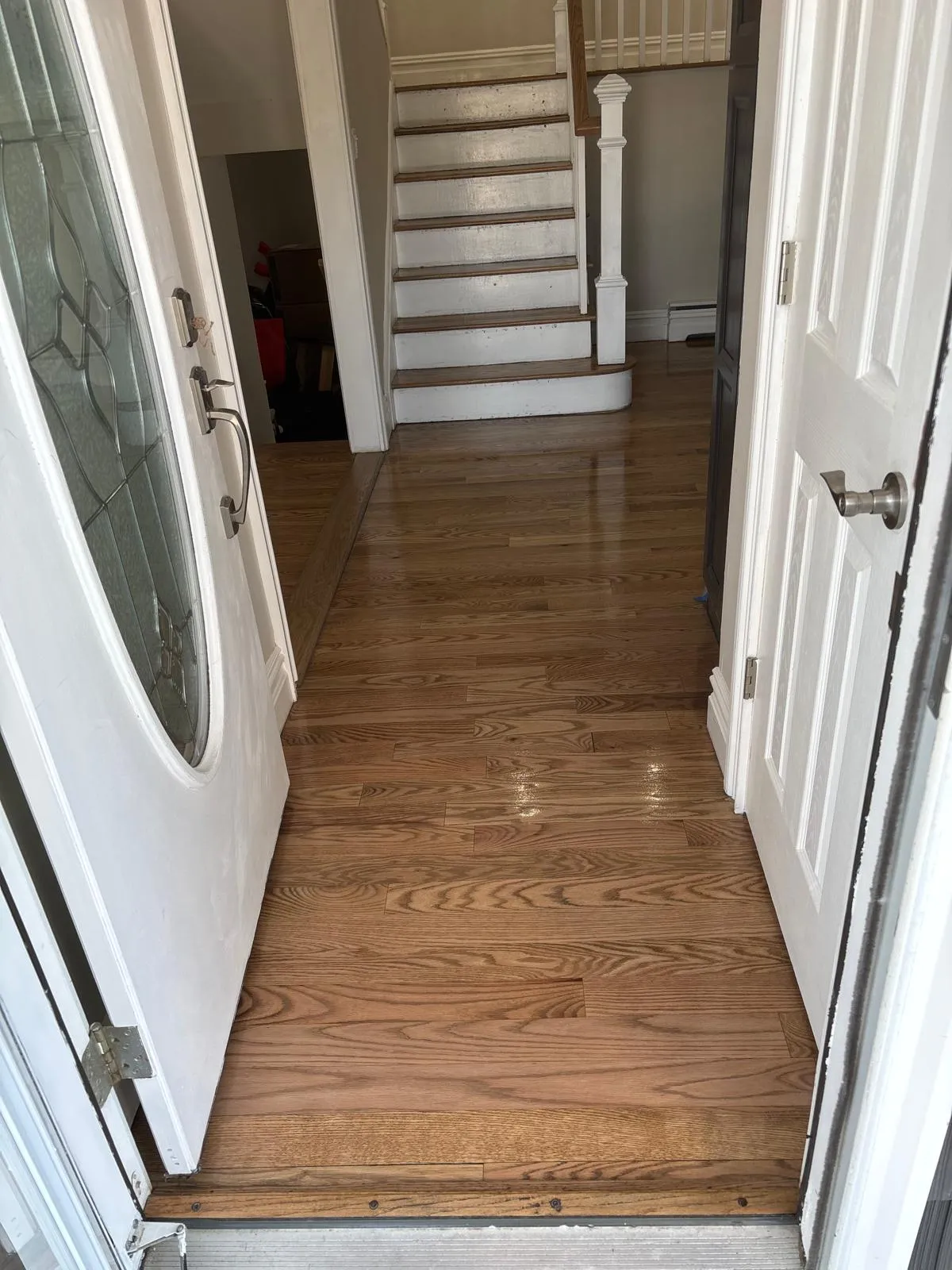
Keeping the floor a Leawood house was designed around
Around here the wood was chosen to be part of the architecture, not a surface under the furniture. Restoration is how a floor like that keeps going for another few decades instead of being torn out and started over.
How much floor you still own
Every restoration conversation runs into the same ceiling eventually, and it is a physical one. A board can only give up so much thickness before the fasteners that hold it down start showing. So the first thing we settle in a Leawood house is not color or sheen. It is how much usable wood is sitting above the tongue, because that number quietly decides everything that follows.
There are only a few honest places to read it. A floor register makes a clean window into the edge of a board. So does the threshold at a doorway, or the run of flooring that disappears under a base cabinet and never got walked on. Thiago checks more than one of them, because a main-level floor does not wear evenly: the path between the kitchen and the back door has lived a completely different life from the formal dining room that gets used at Thanksgiving.
What comes out of that reading is a plain answer. Plenty left, and we have room to work. Getting thin, and the approach turns careful and the sanding gets minimal. Nearly gone, and we say so before anybody spends money. Nobody can hand you that answer from a phone call, and we do not pretend otherwise.
What restoration covers here
- Thickness read at registers, thresholds, and cabinet runs
- Decades of stacked finish taken back to bare wood
- Pet damage cut out and replaced rather than sanded at
- Sun-faded rooms brought level with shaded ones
- Species, width, and grain matched on replacement runs
- Pattern work and inlaid borders repaired course by course
- Stair treads brought back with the floor they meet
Getting back down to the actual wood
Reading the buildup
A floor that has been recoated every few years for thirty years is not one finish. It is a stack of them, sometimes different chemistries laid over each other, ambered to a shade nobody picked on purpose. The wood underneath is usually lighter and livelier than the owner expects, and we can show you that with one test patch before you commit to anything.
Cutting through it cleanly
Old buildup does not come off politely. It softens, gums up abrasive, and loads a machine fast, so it wants fresh paper changed often and a steadier pace than a straightforward sanding job. Rushing this stage is how you get a floor that looks fine at first and then shows cloudy patches once the light moves across it in the afternoon.
Reading the bare floor
Once everything is off, the floor tells the truth for the first time in decades. Stains that looked hopeless under yellowed finish often turn out shallow. Others go deeper than anyone hoped. We walk you through what is now visible and adjust the plan on the spot rather than pushing ahead with the version we quoted from a guess.
Building the color back
Then the color goes on in stages, checked against the rooms it flows into, so a restored main level reads as one floor rather than a set of neighboring projects. We finish with LOBA systems and pick a sheen that suits the age of the house instead of the brightest one available.
Pets, sunlight, and the rooms in between
Two things mark up a Leawood main level more than traffic ever does. The first is a pet accident that soaked in and sat. That damage is not on the surface, it is in the wood and often into the subfloor below, which is why sanding harder never works on it. The honest fix is cutting the affected boards out, treating what is underneath, and setting replacement pieces in.
The second is light. A south-facing room with tall windows bleaches its floor over the years, and the strip that lived under an area rug stays the color it started. Pull the rug and you get a rectangle. Restoration lets us bring both back to the same footing and blend the transitions where one room opens into the next, which matters enormously in a house with long open sightlines.
Neither problem is exotic. Both need to be found before pricing rather than discovered halfway through, and both are exactly what Thiago is looking for when he walks a floor with the furniture still on it.
How the visit works
You call or send the form, and Thiago comes to see the floor in person, usually inside a few days. He measures, checks what is under and around the flooring, reads the wear at several spots, and lays out options at more than one budget. Then you get a straight price in writing with the reasoning attached, from a family-run crew twenty minutes away in Shawnee.
Matching what an older Leawood floor already is
Restoration gets hard at the seams. Where boards have to be replaced, the new stock has to agree with the old on species, width, cut, and grain character, and it has to do that after finish, not in the box. Wood that looks close at the supplier can drift a shade or two apart once color goes over it, so we choose with the finished floor in mind and we test before committing a room to it.
Pattern work asks for more. A herringbone field, a chevron run, an inlaid border framing a room: those were laid out by somebody working to a plan, and a repair that ignores the plan announces itself forever. We take the pattern apart only as far as we have to, keep the original layout intact, and rebuild outward from what is still sound. Stair treads get the same treatment when they meet a restored floor, because a beautiful main level running into mismatched stairs is a job that stopped one step early.
Where this work happens
These calls come from the established streets near Lee Boulevard and from the estate homes out around Hallbrook, plus office and retail suites near Town Center where an original floor is worth keeping. Everything runs out of the same Johnson County shop.
Realtors call ahead of a listing for the same reason: a refreshed floor moves the sale. The Leawood page covers everything else we do in town, the restoration service page explains our approach across the metro, and the gallery shows how these finish up.
Related work: Refinishing · Floor Repair · Dustless Sanding · Installation
What Leawood owners ask us
Questions that come up on the phone often enough to be worth writing down. Yours may not be here. Call and ask it.
Need more help?
Thiago fields the questions personally and is happy to talk through an old floor.
(913) 915-3193hardwoodkingsinc@gmail.comHow can I tell whether our floor has enough thickness left?
Lift a floor register and look at the cut edge of a board, or check where the flooring runs under a base cabinet. Thiago reads several of those spots on the first visit, since a hallway and a guest room wear at completely different rates and one reading can mislead you badly.
Our floors look dark and cloudy. Is that the wood or the finish?
Almost always the finish. Coats stacked on top of each other over the years amber as they age and dull the grain underneath. We can sand a small test patch so you see the actual color of your wood before deciding anything about stain.
A dog stain went through in the family room. Can restoration take that out?
Not by sanding. Urine soaks past the surface and often into the subfloor, so more aggressive sanding just thins the board and leaves the mark. We cut out the affected pieces, treat what is beneath, set in matching wood, and blend the color across the repair.
One room is much lighter than the rest from sun exposure. Will that even out?
Yes. Taking everything back to bare wood removes the faded layer, and the color we build afterward is checked room to room as it goes down. Where a rug protected a rectangle of floor, that outline disappears in the same pass.
We have a herringbone section and an inlaid border. Can those be repaired?
They can. We open only the courses that have failed, keep the original layout as the reference, and work outward from wood that is still sound. Pattern repairs need patience and layout time, and we price that honestly rather than guessing at it.
How do we get a price to restore our floors?
Call (913) 915-3193 or send the contact form describing the rooms and what concerns you about them. Thiago comes out from Shawnee within a few days, reads the wear, checks what is under and around the flooring, and hands you a straight price in writing.
When we tell you to replace it instead
Restoration has a limit, and pretending otherwise costs the homeowner twice. If a floor has already been taken down by past crews until the fasteners sit close to the surface, another sanding does not renew it, it ends it. Boards that have gone soft under a long slow leak are the same story: they will not hold a finish and they will not hold a fastener either.
There is also a math problem worth saying out loud. When the count of failed boards climbs high enough, replacing them one at a time stops making sense against simply laying a new floor in the same species and pattern. We would rather walk you through that comparison honestly than sell restoration work that will disappoint you in a year.
When replacement is the answer, we say it standing in the room, and we help you match what was there so the house still reads the way it was built to read. And when the floor can be saved, which is more often than most people expect, we tell you that too, even though it is the smaller invoice.
Straight answers, in writing
- Wear read in person before any number is quoted
- Test patch shown before stain decisions
- Options at more than one budget
- The crew that quotes it does the work
- Licensed, certified, and insured
- Your home left cleaner than we found it
Talk to us
Call (913) 915-3193 or send the details and we will set a time to come look.

Wondering if your floor can be saved?
Describe what you are seeing, whether that is a dulled main level, a stain nobody could get out, or a pattern section that has started to fail. Thiago comes out, reads the wear at several spots, and tells you plainly whether restoration will hold. Either way you leave the conversation with a straight price in writing and nothing chasing you afterward.
Or see the finished work first. Family-run out of Shawnee since 2012, locally certified and licensed, and rated 5.0 on Google.