
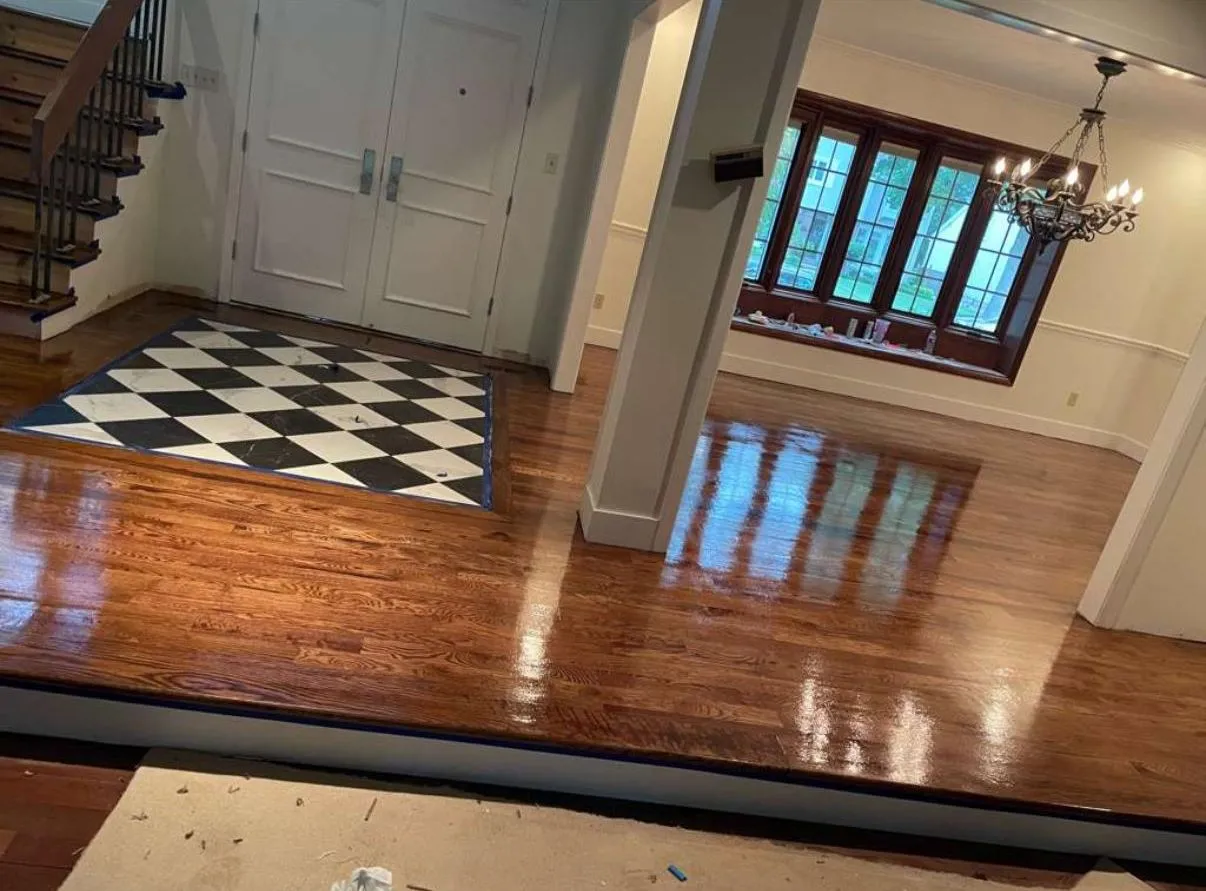
Pattern work set into an old oak floor
Plenty of houses here still stand on the solid oak they were built with in the 1940s and 50s, and that oak makes a good frame for pattern work. A border around a dining room, a herringbone run down a hall, a checkerboard at the front door. Every piece is cut and fit by hand, laid off lines struck from the middle of the room, and sanded flat with the boards around it. Thiago looks at the rooms in person before anything gets drawn.
Borders, herringbone, and a checkerboard at the door
Most of the custom work we do in older houses starts with a floor that is already there. A Cape Cod or colonial from those decades usually has narrow oak strip running through its main rooms, and the pattern gets set into that oak instead of replacing it. A border can frame a living room so the field reads almost like a rug. It can also trace the line where a wall used to stand, which turns an old scar in the floor into something that looks planned from the start. A black-and-white checkerboard at the entry does a similar job for a foyer: the front door gets a floor of its own, and the oak picks up again past it.
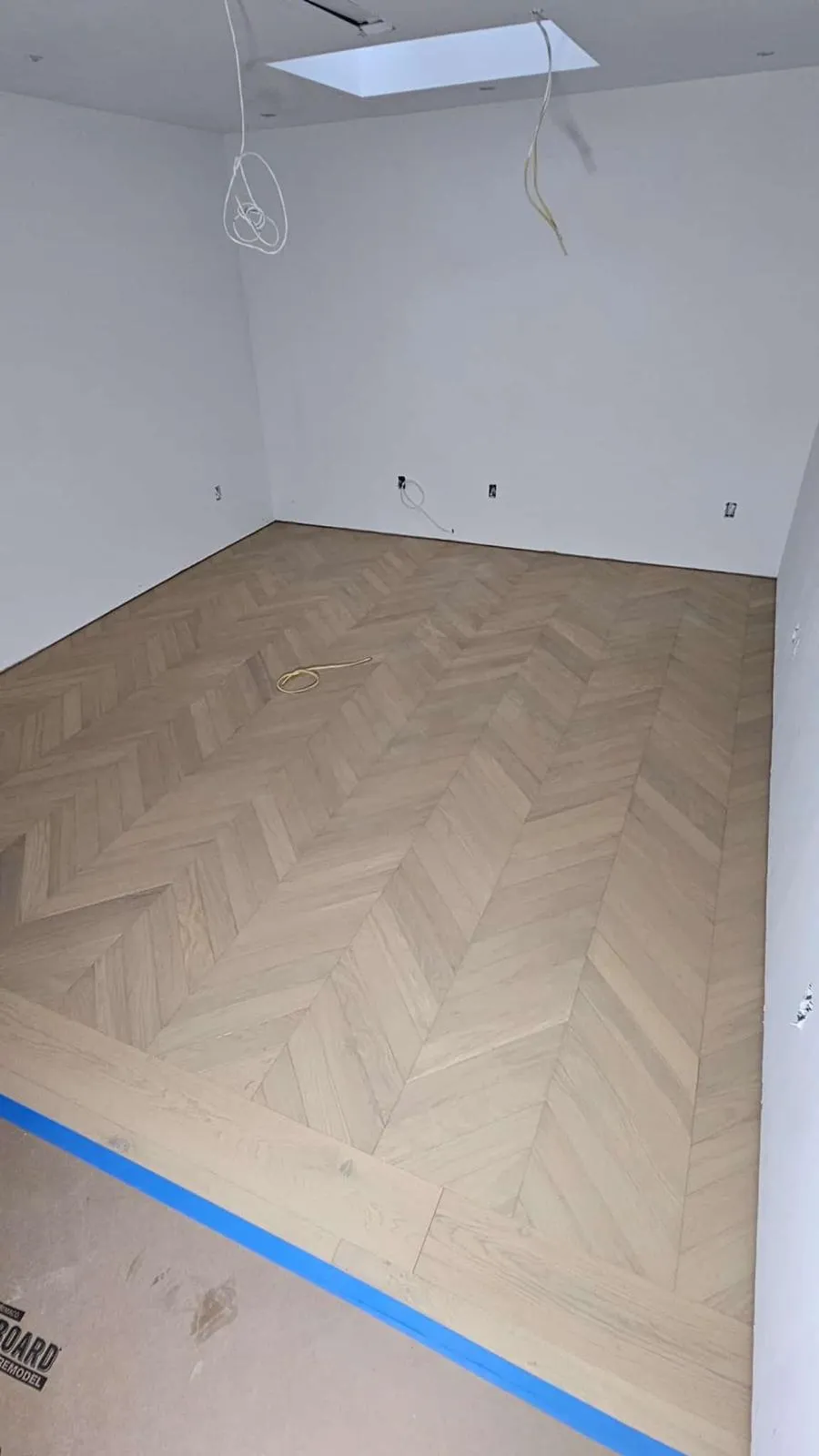
Herringbone and chevron get mixed up all the time. Herringbone uses rectangular pieces with square ends, meeting in a staggered zigzag that looks a bit like brickwork. Chevron pieces are cut at an angle on the ends so they meet in a clean point, and the rows read like arrows running down the room. Both suit a long hallway or a dining room. Parquet, built from small blocks, belongs in a smaller space where a long pattern never gets the chance to develop. We bring samples of each and lay them on your floor, in your light.
What a pattern job includes
- Center lines measured off the room as a whole, never off a single wall
- A dry layout of the pattern before a piece is fastened
- Borders mitered and pieces fit by hand at every doorway
- New pattern stock left to settle in the house beside the oak
- One sanding across the original field and the new work together
- Finish matched so pattern and field share a single sheen
Want more on species, inlays and layouts before we visit? The custom hardwood flooring page goes deeper into the options and how each one gets built.
Laying it out from the middle of the room
Find the true center
Old walls drift. A room in a house this age is rarely square, and a pattern laid tight against one wall will show the error at the far side, where a border tapers or a herringbone row runs off at a slant. So we measure the room in both directions, find its real center, and strike the working lines from there.
Land square at the doors
Doorways are where people actually look. Before anything is fastened, we dry lay the pattern and check where it ends at each opening, so a full chevron point or a whole checker lands at the threshold instead of a thin sliver. If the layout has to shift an inch to make that happen, it shifts on paper first.
Cut and fit by hand
Pattern work does not arrive in finished pieces. Borders get mitered at the corners, herringbone gets trimmed where it meets the border, and checkerboard squares go into the surrounding oak one at a time. That handwork is slow, and it is most of the reason a pattern takes longer than straight strip.
Sanding across the grain
Once a pattern is down, the grain runs several directions on one floor. A sander that cuts clean along one piece will tear across the next, so the sanding takes more passes with finer grits and extra hand work at the edges. The goal is one flat surface where your feet never notice the grain changing direction.
Choosing the wood and how much contrast to use
A pattern only shows if something separates it from the field around it. Sometimes that is a different species, a darker wood for a border or contrasting squares in a checkerboard. Sometimes it is the same oak with the direction changed, which gives a quieter look that shifts as you walk past and the light catches each piece at a new angle. Red oak and white oak sit side by side well when the contrast is meant to be gentle. When you want the pattern to read from across the room, a darker species or a stained piece carries it.
Our materials come through ProSource Wholesale at contractor pricing, so the species list runs deep and the wood costs you less than retail. We will tell you which combinations will still look right once a trend has passed and which ones are likely to date the room. In a house that still has its original oak, the safest choice is usually a pattern that could have been there from the day the house was finished, which means restraint in color and a border that follows the room’s own lines.
One visit, one written number
Thiago comes out, measures each room, and talks through what a pattern would involve at more than one level of detail. You then get a straight price in writing, with the layout and the reasoning attached. That number holds, and nobody calls back later trying to sell you a bigger version of the job.
When plain strip is the smarter floor
Pattern work pays off in the rooms people pass through and pause in: an entry, a dining room, the hall that ties the house together. It rarely pays off in a bedroom that will spend its life under a bed and a rug. And in a lot of these houses the best custom move is the quiet one, sanding and finishing the original strip so it looks the way it did when the house was new. We would rather tell you that on the first visit than sell you a pattern nobody will see.
If a refinish is already on the calendar, adding a border or an entry pattern at the same time means one disruption instead of two, because the whole floor gets sanded and finished in a single run. A whole-house refinish here usually takes four to six days. Pattern work adds to that, and we put the added days in writing before anyone starts, so the schedule you plan around is the one we keep.
Twenty minutes from the shop
We work out of Shawnee, so getting to Prairie Village for a first look is easy to set up. The Prairie Village page covers the original oak in these houses and the repairs we do around it, and every job in the county runs through the same Johnson County crew.
Finished pattern floors and plenty of plain oak from around the metro are in the gallery. Once you know which rooms you are thinking about, tell us about them and we will set a time.
Also in Prairie Village: Sanding · Staining · Replacement · Solid installation
Pattern questions from homeowners here
Asked on site, usually by someone standing in a doorway picturing the finished room. Missing yours? Call and ask it.
Sketch it out with us
Thiago would rather talk a layout through on the phone than have you guess.
(913) 915-3193hardwoodkingsinc@gmail.comCan a pattern be added to the oak floor we already have?
Usually, yes. We cut out the area where the border or inlay will go, set the new pieces into the opening, and sand the whole floor together so old and new sit flush. The existing oak needs enough wear layer left to sand, which we check on the first visit.
Herringbone or chevron, which one suits an older house?
Both can. Herringbone feels a little more traditional because its square ends stagger like brickwork, while the angled ends of chevron meet in a point and read more formal. Either works in a long hall. We lay a few pieces of each on your floor so you can decide in your own light.
Can you build a border where a wall was taken out?
Yes, and it is one of the fixes we enjoy most. When a wall comes out, the floor underneath usually shows a strip of missing or mismatched boards. Framing that line with a border, or running one around the newly joined room, turns the repair into a feature that looks deliberate.
Does pattern work take longer than a regular install?
It does. Layout, dry fitting and hand cutting take most of the extra time, and sanding across several grain directions adds a little more. Every one of those days shows up on the written schedule before work starts, so nobody has to rush the finish to catch up.
Will a checkerboard foyer look out of place next to oak?
Not when the scale and colors are chosen with the house in mind. A checkerboard at the front door reads as its own small room, and the oak carries on past the threshold. We size the squares to the entry so the pattern ends cleanly at every edge and doorway.
How do we get a price for a custom floor?
Call (913) 915-3193 or send the contact form with the rooms and an idea of the pattern you like, plus photos if you have them. Thiago comes to the house, measures, and gives you a straight price in writing with the layout explained alongside it.
Have a pattern already in mind?
Send a photo of something you liked, or just tell us which room. Thiago comes out from Shawnee, looks at the oak that is down now, and sketches what would fit, with a straight price in writing to go with it.
Or browse finished floors first. Family-run in Shawnee since 2012, licensed and certified, with a 5.0 rating from customers across the KC metro.