
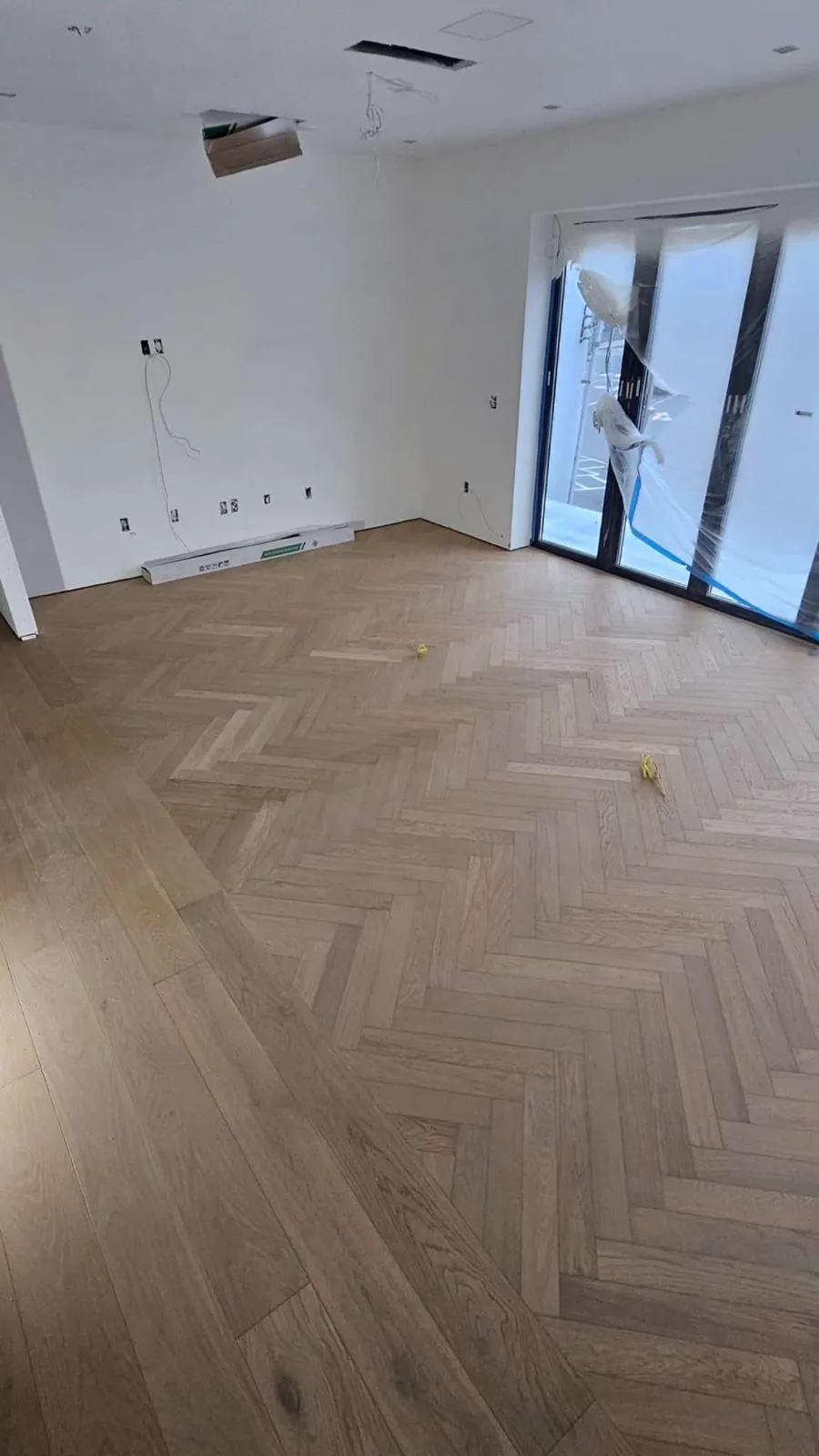
Pattern work belongs in houses that already have character
A herringbone hall or a bordered dining room can look like a magazine idea dropped into the wrong house. In the right one it looks like it was always there. The Cape Cods and colonials built here in the postwar years have proportions, trim and doorways that suit a bit of pattern, provided it is placed with some restraint.
This is about where a border or pattern earns its keep in an older home, how the work is actually laid out and fitted, and when the smarter call is a plain strip floor.
A border can solve a real problem
The most useful border is often the one that fixes something. When a wall comes out between two rooms, the old floors on each side rarely line up perfectly. Boards may run in slightly different directions, or a strip of subfloor shows where the wall stood. A border that traces the old wall line, or frames the newly opened space, turns that scar into a deliberate feature.
Borders also give a room a finished edge. Strip oak running straight into a wall is fine, but a band of boards turned parallel to the walls, sometimes in a contrasting species, makes a dining room or front room feel composed. It also hides the fact that walls in an older house are rarely perfectly straight, since the border takes up the variation instead of the field.
Our custom hardwood flooring page for Prairie Village shows the range of work, from a simple band to a full pattern room.
Sizing a pattern to a narrow hall
The halls in these houses are narrow, and that changes how a herringbone or chevron should be cut. With short pieces, a narrow hall ends up with more cut ends at the walls than whole pieces in the middle, and the pattern never gets room to repeat. Longer pieces leave fewer cut ends and let the zigzag run a few full rows across before it meets the border.
Direction matters as much as size. A chevron reads as a row of arrows, so the points should run toward the room the hall leads into, not back at the front door. A herringbone has no point, which makes it the more forgiving choice in a hall with doors on both sides.
Both patterns use more wood than strip oak, since every angled or mitered cut leaves an offcut, and chevron leaves the most. That gets planned into the order up front, so the job does not stall halfway waiting on more boards from a different lot.
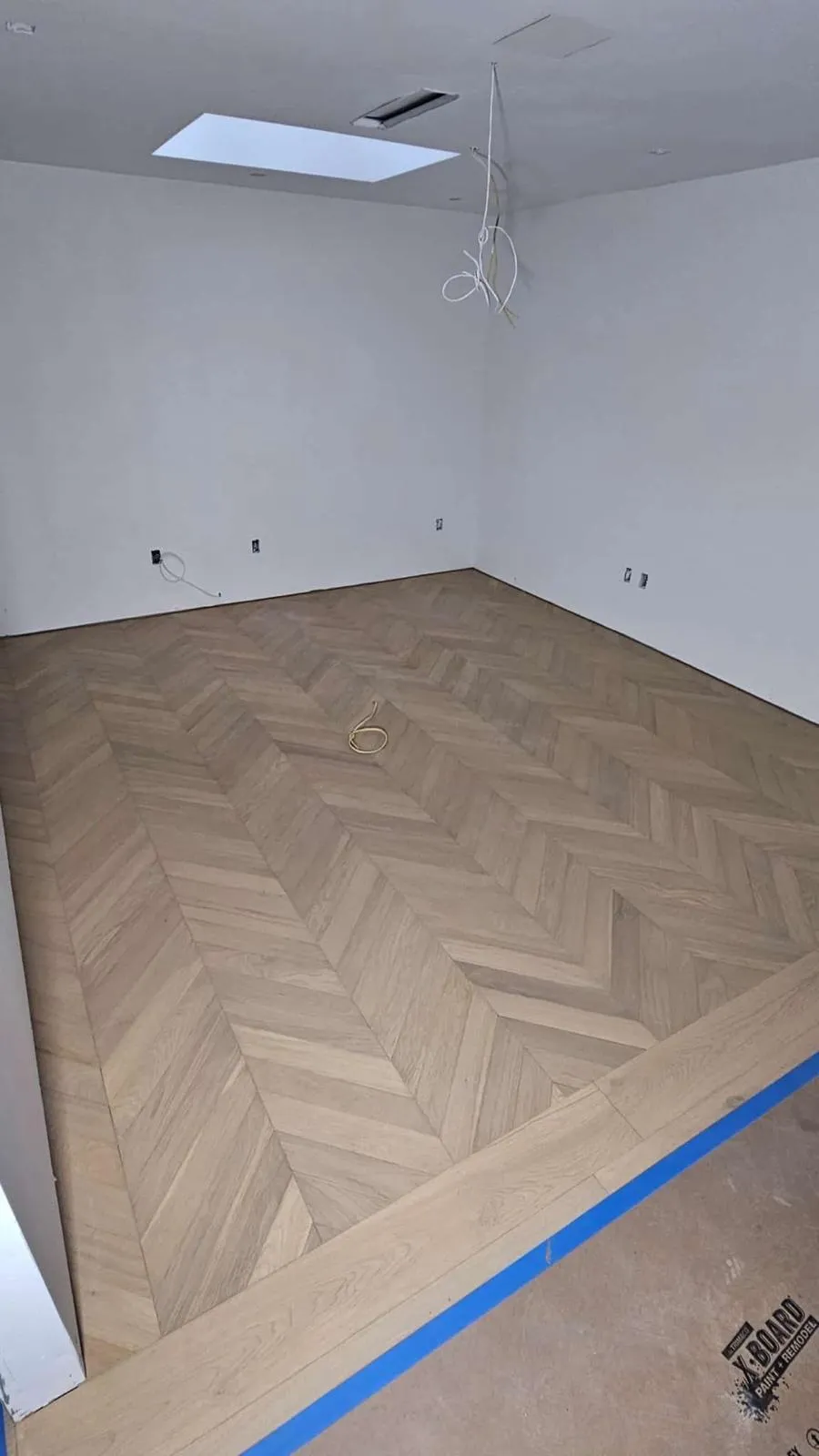
Laying it out so it lands square
A pattern floor lives or dies on layout. Before a single piece is fastened, the room is measured and a center line is snapped, usually through the middle of the main doorway or along the axis you see first when you walk in. Everything works outward from that line.
The reason is simple: a pattern that starts against a wall inherits every bend in that wall. In an older house, where walls can drift out of square, starting from the edge leaves a herringbone that drifts visibly crooked by the far side of the room. Starting from a center line keeps the pattern true where people look, and the border absorbs whatever the walls are doing.
Doorways get special attention. The point of a chevron or the zigzag of a herringbone should land cleanly at the opening, never half a board off. That is planned on paper and checked with dry-laid pieces before the adhesive or nails go in.
Cut by hand, sanded across the grain
Pattern floors are slow because nearly every piece is handled individually. Border corners are mitered, field pieces are trimmed to meet the border, and anything around a hearth, a column or a stair nosing is scribed to fit. A strip floor can cover a room in a day. A pattern room of the same size takes much longer, and that time is where the quality comes from.
Sanding is its own challenge. In a strip floor the sander runs with the grain. In herringbone or parquet, the grain changes direction every few inches, so every pass is partly across the grain. Cross-grain scratches are what show under stain and finish, so the sanding sequence has to be planned carefully, with extra fine passes and close attention at the border where two directions meet.
That is also why a pattern is usually installed unfinished and finished on site, so the whole floor is leveled and coated as one surface.

Contrast, species and knowing when to stay plain
A border in the same oak as the field is quiet and elegant. A border in a darker species gives a sharper line and more formality. A black and white checkerboard set into an oak entry is about as bold as an old house can take, and in a front hall with a staircase it can look exactly right. Each step up in contrast is a step up in commitment, so we sample the combinations side by side before ordering.
The field species matters as much as the border. A pattern cut from the same kind of oak as the rest of the house will age along with it, so a hall laid this year still sits comfortably beside rooms laid decades ago. Mixing in a species the house has never had makes the new work announce itself, which is fine when that is the point and awkward when it is not.
Plain strip oak is still the better choice in plenty of rooms. A small bedroom, a room with lots of furniture covering the floor, or a house where the original strip runs unbroken through several rooms often looks best left continuous. Interrupting a good run of old oak with a new pattern can break the flow that makes these houses feel unified. A pattern does the most work in a room people stop in, like an entry or a dining room.
Questions about patterns and borders
Does a border mean pulling the trim?
Usually just the shoe molding along the bottom of the baseboard comes off, so the border can run tight to the wall. The baseboards themselves normally stay where they are, and the shoe goes back on once the finish has cured.
Is herringbone harder to keep looking good?
Not really. Once finished, it cleans and wears like any other site-finished oak floor. The main difference is that small gaps and seasonal movement show as a pattern of tiny lines in more directions, which most people find adds character. Refinishing it later takes more care in sanding.
Do we need to do the whole house in a pattern?
No. A pattern can live in just an entry, a hall or a dining room, framed by a border and meeting the plain strip at the doorways. Keeping it to one or two rooms tends to look more intentional, and it lets the original floor stay as it is elsewhere in the house.
Talk through the layout before you choose
A pattern is the most personal floor in the house, and the planning is where it goes right or wrong. If the room you are thinking about has damage to deal with first, our floor replacement work covers that step.
Sketch the pattern with the room in front of you
Thiago measures the room, finds the center line, lays out samples of the patterns and borders you like, and gives you a straight price in writing. The rest of what we do around the neighborhood lives on the Prairie Village page.