
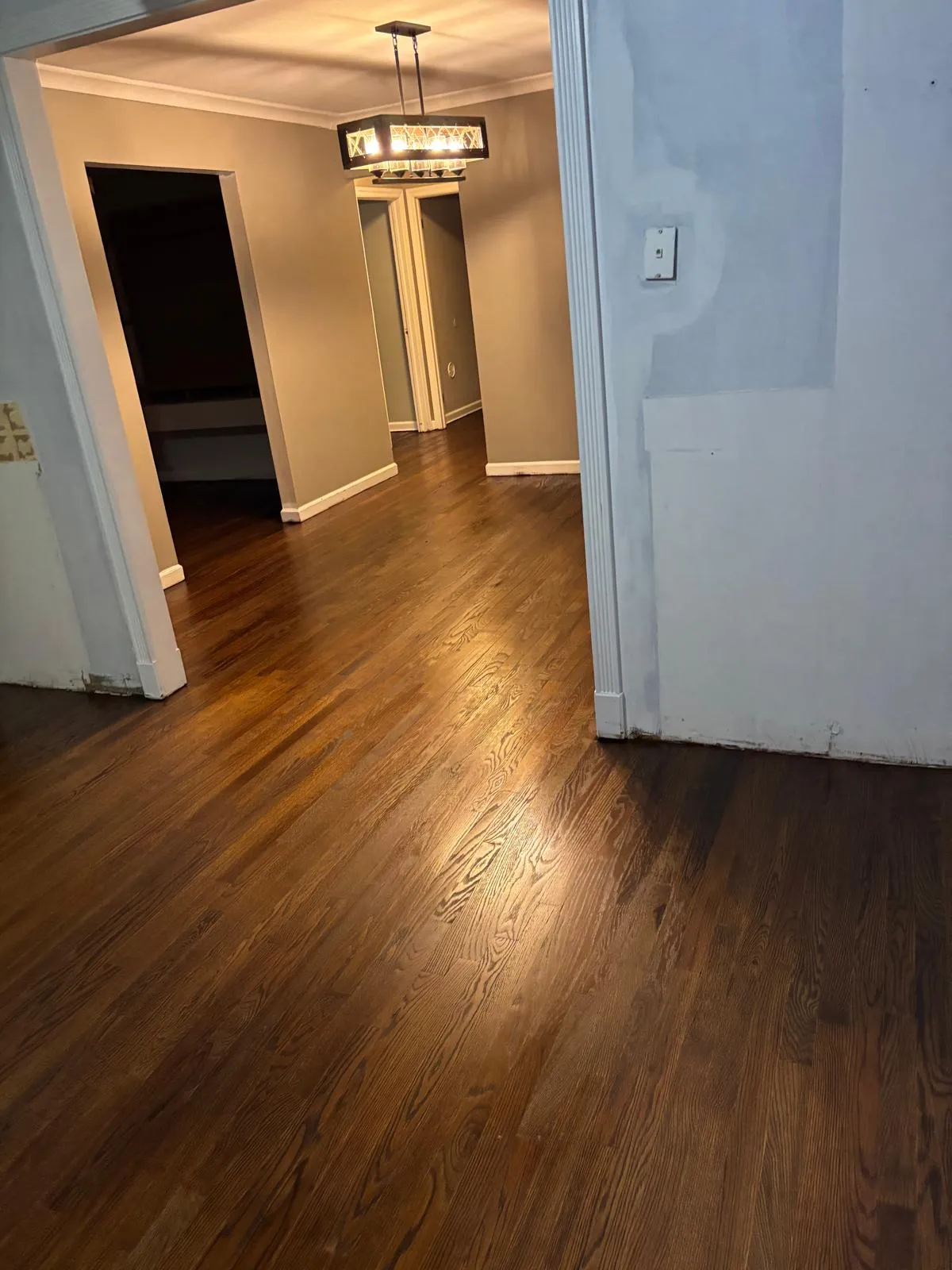
The floor came out beautifully and now the stairs look terrible
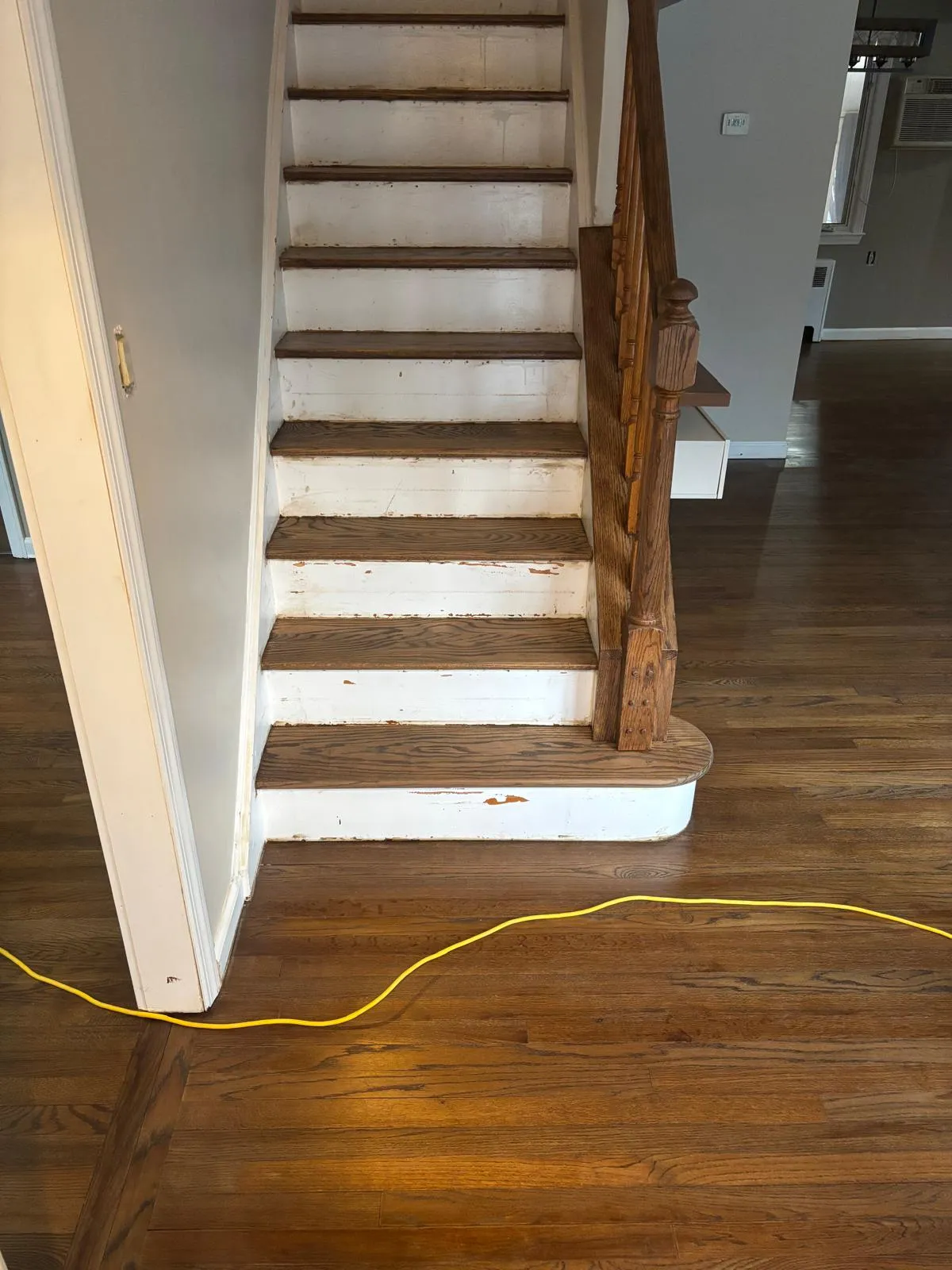
Nobody plans it this way. A main level gets brought back, the color is right, the light moves across it properly for the first time in years, and then the eye travels to the staircase and stops. The treads have not changed. They are still carrying whatever tone and whatever wear they had before, and against a renewed floor they suddenly look far worse than they did last month.
That is not bad luck. It is what happens whenever a large surface is refreshed and an adjoining one is not, and the staircase is the surface most likely to get left out of the scope. Worth understanding before the decision rather than after, because doing the two together is straightforward and doing them a year apart is not.
Treads live a completely different life
A staircase is not floor that happens to be tilted. It is a set of components taking a kind of punishment nothing on the main level experiences, and understanding that explains most of what makes stair work its own trade.
Every step concentrates a person’s full weight onto a strip a few inches wide near the front edge of a tread. A floor spreads traffic across an entire room; a staircase funnels it into the same narrow band thousands of times. That is why the nosing wears first and hardest, why the middle of each tread hollows before the sides do, and why a stair that gets the same use as a hallway looks considerably older than it.
Treads are also at eye level and hand level in a way floors never are. Coming down a staircase you are looking directly at the surface of each step from a few feet away, not from standing height across a room. Details that would vanish in a floor read clearly here, which is both why stairs are unforgiving and why doing them well makes such a visible difference.
None of it can be done with a floor machine
The practical consequence of all that geometry is that stair work is hand work. A floor machine needs a run of open surface, and a staircase offers nothing of the kind. Each tread is a small isolated plane with a return on one or both sides, a riser meeting it at a right angle, and often balusters coming down into it that cannot be removed casually.
So treads are sanded individually, edge by edge, with the transitions between tread and riser worked by hand and the areas around each baluster taken carefully. It is slow, and it is slow in a way that does not compress with more people or better equipment. The honest framing is that a staircase can take as long as a good-sized room, and anybody who prices it like a few square feet of floor either does not know that or is planning to rush.
Stain behaves differently here too. Hand-sanded wood takes color a little differently than machine-sanded wood does, so a tread finished with the same product as the floor can land slightly off if nobody accounts for it. That is why samples get tested on the treads themselves rather than assumed from the floor’s result.

Replace a tread or bring it back
Not every tired step needs replacing, and the decision follows the same logic as anywhere else in the house. A tread with plenty of thickness left and nothing worse than wear is a candidate for sanding and refinishing. A tread that has split, gone soft, or been worn through at the nosing is past that, and a replacement is both cheaper in the long run and safer.
Replacement raises the matching problem in a concentrated form. A new tread sits inches from its neighbors, so any disagreement in species, grain, or color is visible from a foot away rather than across a room. New stock has to be chosen against the actual staircase and colored toward what the existing treads have become, which is a different target from matching the floor at the bottom of them.
The nosing is where careful work shows most. That front edge is the part a hand touches, a foot lands on, and an eye follows down the whole flight. A nosing profile that does not match its neighbors makes a staircase look assembled from parts, even when the color is perfect. Getting that profile right is a large share of what separates stair work that reads as original from stair work that reads as a repair.
Doing it in the same visit is the whole point
The strongest argument for handling stairs alongside a floor is not scheduling convenience. It is color. When treads and floor are finished in the same pass, with the same materials, sampled together and applied within the same conditions, they land as one surface. Coming back later means matching a cured coating that has already begun its own slow shift, which is a genuinely harder target and sometimes an imperfect one.
There is a disruption argument too. A staircase is usually the only route between floors, so working on it affects the household more than any single room does. Folding that into a week when the main level is already being worked means one period of inconvenience rather than two.
Where a floor carries a border or a pattern field, the stairs become part of that composition rather than a separate item. A landing that continues the field, treads colored to sit with it, and a nosing that agrees with the rest of the millwork is what makes a staircase read as belonging to the house instead of standing beside it.
What we look at on the first visit
Reading a staircase takes a few minutes and answers most of the questions people arrive with. Thiago checks the thickness left in the treads, the same way he reads a floor, since a stair that has been sanded before may have less to give than it appears. He looks at how the nosings are wearing, whether any tread flexes underfoot, and how the balusters are set, because that determines how much can be done without disturbing the railing.
He also looks at where the staircase lands. A flight opening directly onto a restored main level is judged against that floor constantly; one tucked behind a wall is judged more on its own terms. That affects how far the color matching has to be pushed and, sometimes, whether the two projects genuinely need to happen together.
Then you get a couple of routes at different spending levels, and a straight price in writing to weigh them against. The crew is family run out of Shawnee, twenty minutes from most of this city, and the person who looked at the staircase is the person whose crew does the work.
What Leawood homeowners ask about stairs
Can we do the floor now and the stairs next year?
You can, and people do, but know that matching color to a cured coating a year later is harder than matching it the same week. The floor will have started its own slow shift by then. If budget makes splitting the work necessary we would rather plan for it honestly than pretend the later match will be invisible.
Do the railings and balusters have to come off?
Usually not. Most of the work around them is hand sanding done carefully in place, which is part of why treads take the time they do. Occasionally something has to be loosened to reach behind it properly, and if that is the case we tell you before starting rather than after the fact.
Our treads were carpeted for years. Is what is underneath usable?
Often it is, and sometimes it is better than expected, since carpet shields the wood from light and wear even while the tack strip and staples leave their own marks. What we cannot know until we look is whether the treads were finish grade to begin with. Thiago pulls a corner to check before anybody commits to a direction.
Bring the staircase into the conversation early
If a main level is on your list, ask about the stairs in the same phone call. Our Leawood restoration page covers older floors worth keeping, and stair work sits naturally alongside refinishing or a targeted repair depending on what the treads have left.
Have the treads read at the same time as the floor
Thiago comes out from Shawnee, usually within a few days, checks what the staircase has left, and writes down a straight price for it. The thinking behind that number comes with it. More about how we work in town is on our Leawood page.